Bridging Latin America and Europe: The SIMRA Seminar on Audiovisual Services and Regulation
Over the course of eight sessions, experts from Colombia, Spain, Argentina, Uruguay, Mexico, Peru, Brazil, Ecuador and France engaged in discussions and shared studies on the implications of the growth of video-on demand (VOD) services. They explored its impact on public media and the traditional audiovisual industry, its influence on audiences, and the need for new regulatory actions, among other topics.
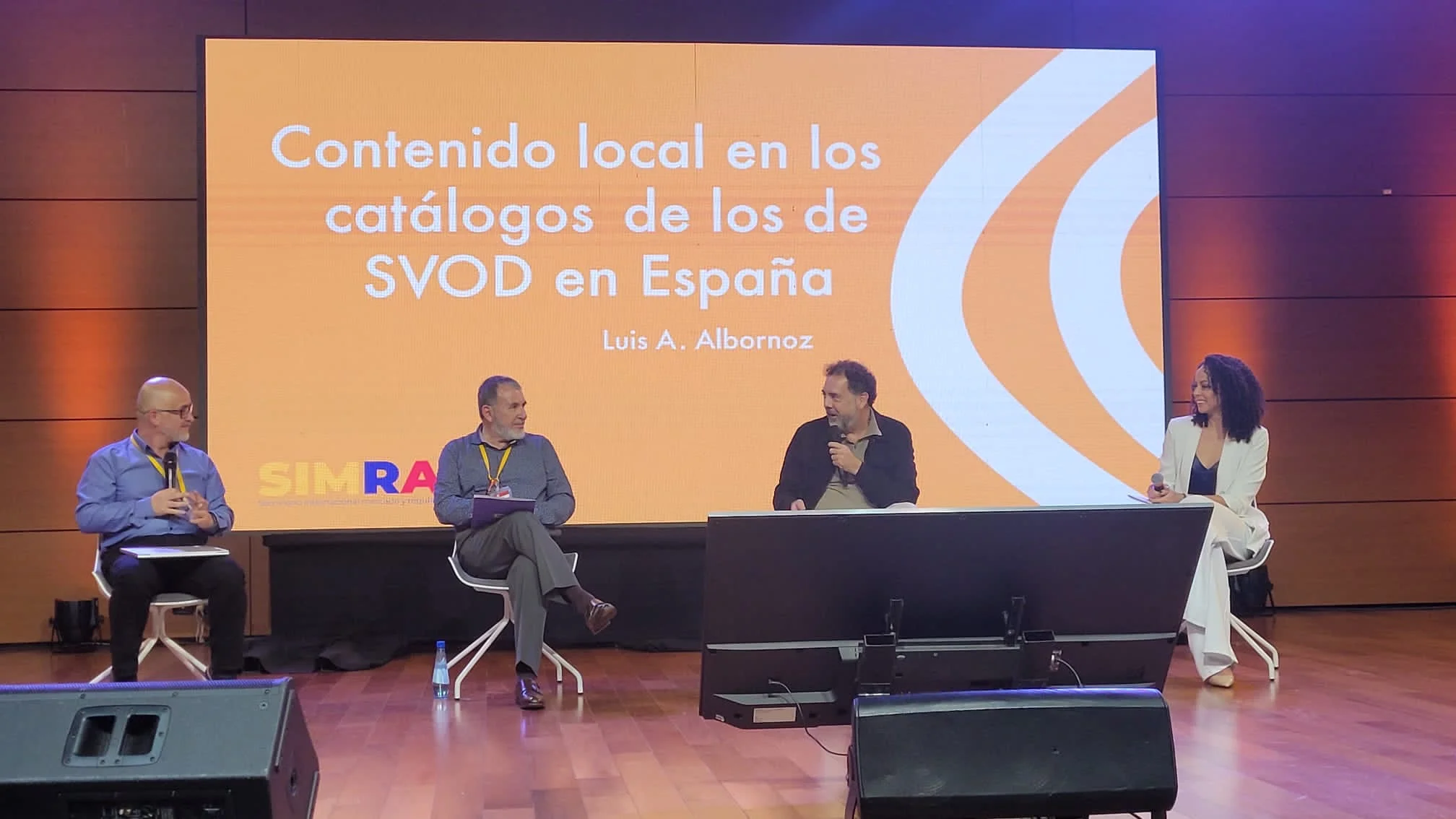
The event featured the participation of Luis Albornoz and María Trinidad García Leiva, professor-researchers at UC3M’s University Institute of Spanish Cinema and the researchers responsible for the execution of the European project REBOOT - Reviving, Boosting, Optimising and Transforming European Film Competitiveness .
Dr. Albornoz presented partial results of the ongoing research conducted by the ‘Audiovisual Diversity’ research group at UC3M regarding the presence of Spanish works in the catalogues of five US-based subscription video-on-demand services (SVOD): Netflix, Prime Video, HBO Max, Disney+ and Apple TV+. During his presentation, Albornoz highlighted the number of Spanish films available on these platforms. In January of this year, the combined catalogues of these five services offered over 1,200 feature-length films including fiction, documentaries and animated movies.
Prime Video, from Amazon, is the service that features the highest number of Spanish audiovisual productions: there are 751 works - including international co-productions with Spanish capital involvement - out of a total of 4,869 titles, which accounts for 15.4 percent of the catalogue. Of these 751 Spanish titles, 73 percent (551 titles) are different types of feature-length films. On the other hand, Apple TV+ falls at the opposite end among the services studied. At the beginning of the current year, its catalogue, consisting of 150 titles, offered only three international co-productions with Spanish capital presence, one of which is a fictional feature film.
Furthermore, in line with the Directive, Spain requires on-demand audiovisual service providers to have at least 30% of European works in their catalogue, ensuring that such works are prominently featured. The peculiarity lies in the fact that the law stipulates a sub-quota to promote linguistic diversity. Thus, at least half of the overall quota, which is 15%, must be reserved for works in Spanish or any of the official languages of the autonomous communities (Basque, Catalan, Aranese, Galician, and Valencian). In any case, out of this sub-quota, at least 40% must be allocated to works in the languages of the autonomous communities, taking into account their population weight and reserving at least 10% for each of them.
Representatives from various organizations, as well as regulatory bodies, participated in the event. Among the participants were ASOTIC (Association of Telecommunications Operators in Colombia), Kantar Media IBOPE, RTVE (Radiotelevisión Española), Tamiyamedia, RTVC Play, CRC (Communications Regulation Commission), CNMC (National Commission of Markets and Competition), and IFT (Federal Telecommunications Institute). The discussions and debates sparked during SIMRA provided an excellent opportunity to reflect on the notions of circulation, competitiveness and diversity within the audiovisual industry at large, with a specific focus on global streamers and European works.
More information here .
Author: Luis Albornoz is the director of the Audiovisual Diversity research group at Carlos III University of Madrid. As a full-time professor in the Department of Communications at UC3M, he teaches courses on Audiovisual System Structure, Geopolitics of Audiovisual Media, and Cultural Economics and Cultural Industries. Currently at UC3M, he is in charge of the Doctoral Program in Media Communication Research and the Master's Degree in Music Industry and Sound Studies. He is a founding member and former president (2007-2013) of the international scientific association Latin Union of Political Economy of Information, Communication, and Culture (ULEPICC). He is also a member of the International Association of Media and Communication Research (IAMCR), where he currently serves on its International Council, as well as the European Communication Research and Education Association (ECREA), and the Spanish Association of Communication Research (AE-IC), where he oversees the Structure and Communication Policies section.
Albornoz holds a degree in Communication Sciences from the University of Buenos Aires and a PhD from the Department of Audiovisual Communication and Advertising I at the Complutense University of Madrid. Among his latest published works "Diversity and the Audiovisual Industry: The Cultural Challenge of the 21st Century" (Mexico: FCE, 2017), "Audiovisual Industries and Diversity: Economics and Policies in the Digital Era" (London/New York: Routledge, 2019), both in collaboration with María Trinidad García Leiva, and "Grupo Prisa: Media Power in Contemporary Spain" (London/New York: Routledge, 2020), in collaboration with Ana I. Segovia and Núria Almiron.