Central European Congress of Modernization in Poland seeks an understanding of the role of cinema as modernization cultural phenomenon
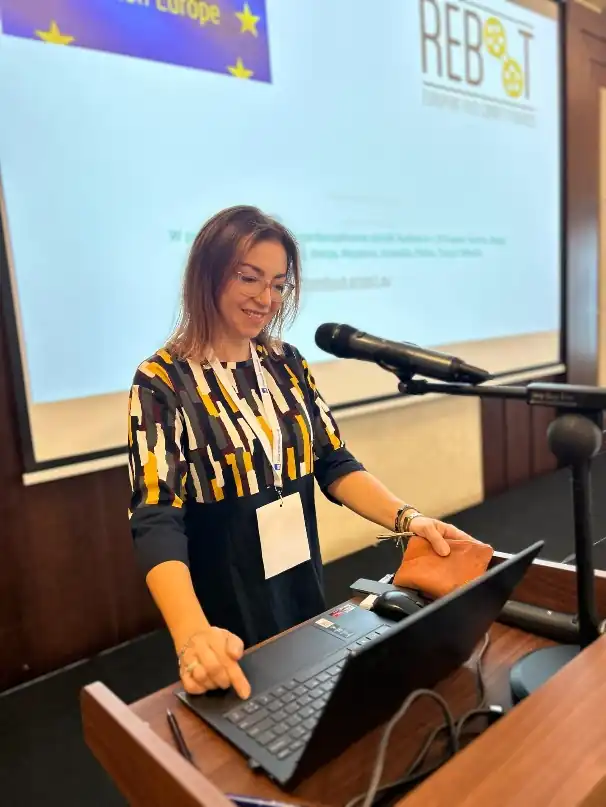
Alicja Waszkiewicz Raviv (University of Warsaw) represented Reboot during the Central European Congress of Modernization, aiming to look at historical modernisation processes in Central and Eastern Europe from an interdisciplinary standpoint. The Congress took place in Rzeszów (in the south of Poland, close to the Ukrainian border). The event brought together academic circles from Central and Eastern European nations and global representatives (e.g. from India and South Africa) who study economics, social history, social communication and media studies, philosophy and pedagogy.
In order to attain greater levels of economic, and political development, the notion of modernization essentially refers to the pursuit of change and the shift from conventional and antiquated ways of living to more contemporary and effective ones. Modernisation research also focuses on social and cultural issues, such as changes in social structure, the development of mass media culture or urbanization processes. In the context of "Younger Europe," attention can be paid to the specific challenges faced by particular countries in the processes, such as catching up with economic development, fighting corruption, building democracy, and preserving cultural and linguistic identity in the age of globalization. Depending on each nation's culture, history, and political climate, modernization has had different implications for Western, Central, and Eastern European countries and their cultural perspectives. Media, especially the audio-visual industry, are essential in transmitting ideological content and telling the story of progress and pitfalls of discussed changes.
Having distinct histories and cultures, Poland, Romania, Hungary, the Czech Republic, and Slovakia all underwent separate modernization processes, each with unique traits. For instance, Poland, a nation that experienced communist rule and partition, had to deal with issues relating to the economic policies and development discontinuities imposed by communist regimes. Conversely, after the Soviet era, Hungary had challenges but swiftly bounced back to become one of the region's fastest-growing nations. The nation's breakup and the establishment of two independent republics presented unique difficulties for the Czech Republic and Slovakia, which were a part of Czechoslovakia until 1993.
In order to attain greater levels of economic, and political development, the notion of modernization essentially refers to the pursuit of change and the shift from conventional and antiquated ways of living to more contemporary and effective ones. Modernisation research also focuses on social and cultural issues, such as changes in social structure, the development of mass media culture or urbanization processes. In the context of "Younger Europe," attention can be paid to the specific challenges faced by particular countries in the processes, such as catching up with economic development, fighting corruption, building democracy, and preserving cultural and linguistic identity in the age of globalization. Depending on each nation's culture, history, and political climate, modernization has had different implications for Western, Central, and Eastern European countries and their cultural perspectives. Media, especially the audio-visual industry, are essential in transmitting ideological content and telling the story of progress and pitfalls of discussed changes.
Having distinct histories and cultures, Poland, Romania, Hungary, the Czech Republic, and Slovakia all underwent separate modernization processes, each with unique traits. For instance, Poland, a nation that experienced communist rule and partition, had to deal with issues relating to the economic policies and development discontinuities imposed by communist regimes. Conversely, after the Soviet era, Hungary had challenges but swiftly bounced back to become one of the region's fastest-growing nations. The nation's breakup and the establishment of two independent republics presented unique difficulties for the Czech Republic and Slovakia, which were a part of Czechoslovakia until 1993.
All of these nations shared the necessity of conducting economic history research. Understanding historical modernization processes and determining the elements that led to their success or failure are made more accessible by this research. Lessons from this study can be used to enhance modernization procedures going forward. Decades of communist and socialist governance in Romania and Poland postponed progress. Countries from the CEE region developed a particular type of cinema, reflecting those motives. Romanian cinema achieved prominence in the 2000s with the Romanian New Wave movement that often incorporated a genre of realist and minimalist films that won multiple awards at the Cannes Film Festival and the Berlin International Film Festival.
Polish phenomena reflecting these times bring back a very successful film: “Zimna Wojna”/“Cold War” (2018) by Paweł Pawlikowski. It gained global recognition and high financial revenue. “Cold War” grossed $4.6 million in the United States and Canada and $20.5 million in other territories, for a total of $25 million worldwide. The film won, for example, the European Film Awards and the Polish Film Award. The director of Cold War has also won Best Director at the 71st edition of the Cannes International Film Festival.
Alicja Waszkiewicz-Raviv – Poland’s team member of Reboot, took part in the debate about the role of films in modernization processes and the importance of incorporating “lessons from the past” into contemporary research on the dynamic cinema industry. The issues of risk management and risk society were also emphasised, with hope given the growing interest among young audiences in film creation techniques and film production. Alicja spoke about indicative findings from VOD study and findings from semi-structured interviews, highlighting the potential of CEE cinema and cultural implications.
The results of scholarly deliberations in Rzeszów will be published under the open access formula as a printed version in the form of reviewed monographs – in Polish and English, as well as a digital version on an event- specific Internet platform .
Polish phenomena reflecting these times bring back a very successful film: “Zimna Wojna”/“Cold War” (2018) by Paweł Pawlikowski. It gained global recognition and high financial revenue. “Cold War” grossed $4.6 million in the United States and Canada and $20.5 million in other territories, for a total of $25 million worldwide. The film won, for example, the European Film Awards and the Polish Film Award. The director of Cold War has also won Best Director at the 71st edition of the Cannes International Film Festival.
Alicja Waszkiewicz-Raviv – Poland’s team member of Reboot, took part in the debate about the role of films in modernization processes and the importance of incorporating “lessons from the past” into contemporary research on the dynamic cinema industry. The issues of risk management and risk society were also emphasised, with hope given the growing interest among young audiences in film creation techniques and film production. Alicja spoke about indicative findings from VOD study and findings from semi-structured interviews, highlighting the potential of CEE cinema and cultural implications.
The results of scholarly deliberations in Rzeszów will be published under the open access formula as a printed version in the form of reviewed monographs – in Polish and English, as well as a digital version on an event- specific Internet platform .