What is the economic impact of the European Film Industry (EFI) at local level?
The European Film Industry (EFI) is more than just an artistic enterprise —it’s also a key player in local economies, creating connections with other industries and driving growth in unexpected ways. A recent study, part of the REBOOT project, dives into how the film sector contributes to local and regional economies beyond its direct impact, shedding light on its hidden influence. The analysis of the economic impact distinguishes between direct and indirect economic effects. While the analysis of the direct economic effect uses traditional variables, such as the contribution of the EFI to EU countries employment, added value, and net returns. The analysis of the indirect economic impact of EFI is carried out applying the concept of economic embeddedness, which measures the degree to which the industry is integrated into local economies.
What Does “Economic Embeddedness” Mean?
The concept of embeddedness addresses how deeply connected the film industry is to its surrounding economy. For example, a film production that hires local workers, uses local suppliers, and collaborates with nearby businesses has a high level of embeddedness. This means the economic benefits stay within the community, supporting local jobs and creating a ripple effect in other industries. The concept of sectoral embeddedness has been extensively used in economics to study regional resilience (Kitsos et al., 2019), the relation between Multinational Corporations’ embeddedness and regional well-being (Pilo, 2023), and innovation (Breschi & Lissoni, 2007). The data used to measure the EFI embeddedness in Europe are retrieved from the EUROSTAT's FIGARO input-output tables, which provide insights into the flow of goods and services between economic sectors at the European level.
We calculate embeddedness as the ratio of domestic intermediate flows within the sector to the total (domestic plus international) flows. Higher values indicate stronger local integration, which can act as a buffer against global economic shocks.
The analysis also regionalizes embeddedness using employment as a weighting factor. This allows the study to highlight regional nuances in the industry’s integration across Europe’s NUTS2 regions.
We perform a comparative analysis with the European CCI embeddedness and some other relevant non-EU countries, to better highlight the EFI embeddedness characteristics (e.g. United Kingdom, United States, Japan, and Korea).
Key Findings About EFI’s Local Impact
1. National-Level Insights
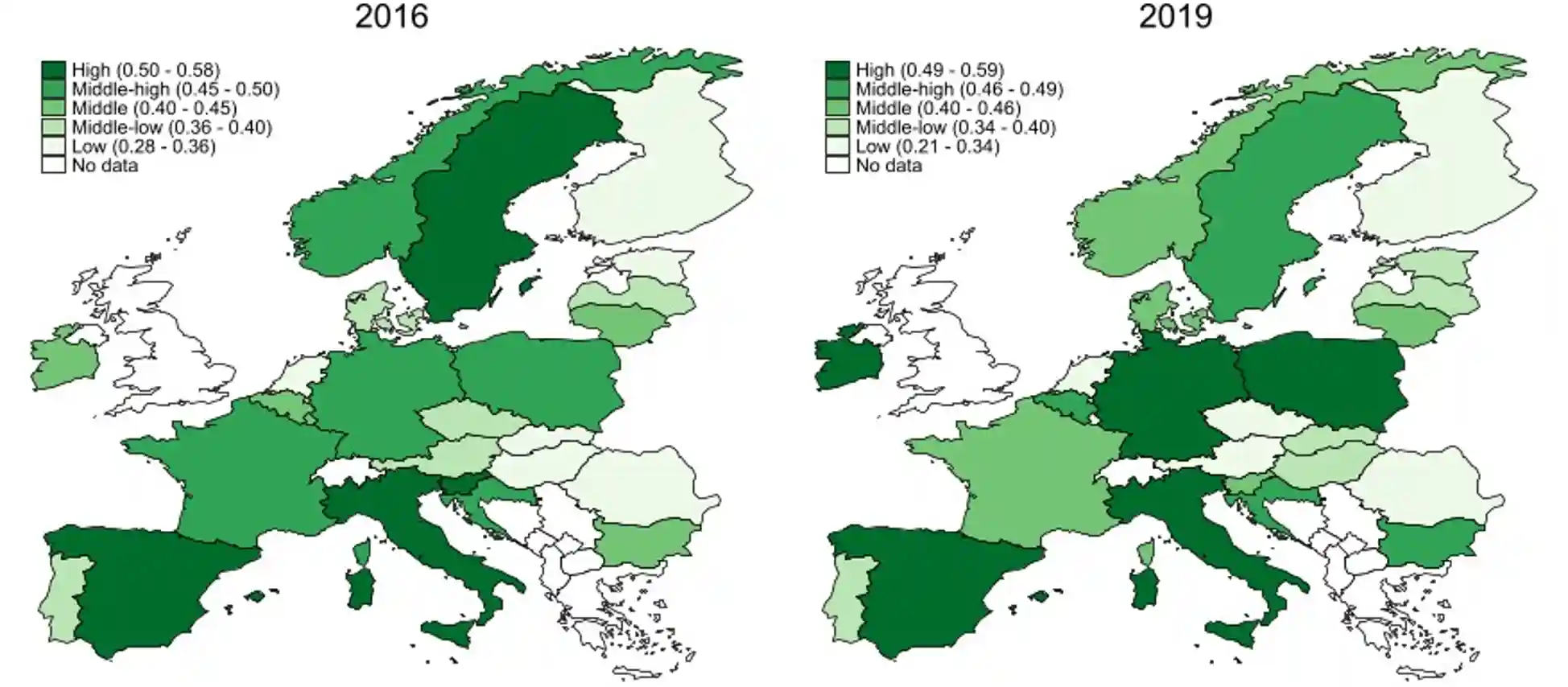
The study reveals substantial heterogeneity in EFI embeddedness among European countries. Spain and Italy emerge as leaders, with embeddedness values exceeding 0.5, signaling strong local integration. In contrast, countries like the Netherlands and Cyprus exhibit significantly lower embeddedness (<0.3), indicating a heavier reliance on international supply chains (see Figure 1 above). Interestingly, competitor countries such as Japan demonstrate even higher embeddedness levels (0.65), suggesting opportunities for Europe to enhance its local linkages.
2. Temporal Trends
Between 2016 and 2019, embeddedness levels showed dynamic changes. For instance, Ireland experienced a notable increase (+0.11), reflecting improved local integration, while Luxembourg saw a decline of the same magnitude. These shifts underline the evolving nature of EFI’s economic ties and its sensitivity to policy and market changes (see also Figure 2 below).
Figure 2 – Map of EFI Embeddedness at country level
What Does “Economic Embeddedness” Mean?
The concept of embeddedness addresses how deeply connected the film industry is to its surrounding economy. For example, a film production that hires local workers, uses local suppliers, and collaborates with nearby businesses has a high level of embeddedness. This means the economic benefits stay within the community, supporting local jobs and creating a ripple effect in other industries. The concept of sectoral embeddedness has been extensively used in economics to study regional resilience (Kitsos et al., 2019), the relation between Multinational Corporations’ embeddedness and regional well-being (Pilo, 2023), and innovation (Breschi & Lissoni, 2007). The data used to measure the EFI embeddedness in Europe are retrieved from the EUROSTAT's FIGARO input-output tables, which provide insights into the flow of goods and services between economic sectors at the European level.
We calculate embeddedness as the ratio of domestic intermediate flows within the sector to the total (domestic plus international) flows. Higher values indicate stronger local integration, which can act as a buffer against global economic shocks.
The analysis also regionalizes embeddedness using employment as a weighting factor. This allows the study to highlight regional nuances in the industry’s integration across Europe’s NUTS2 regions.
We perform a comparative analysis with the European CCI embeddedness and some other relevant non-EU countries, to better highlight the EFI embeddedness characteristics (e.g. United Kingdom, United States, Japan, and Korea).
Key Findings About EFI’s Local Impact
1. National-Level Insights
The study reveals substantial heterogeneity in EFI embeddedness among European countries. Spain and Italy emerge as leaders, with embeddedness values exceeding 0.5, signaling strong local integration. In contrast, countries like the Netherlands and Cyprus exhibit significantly lower embeddedness (<0.3), indicating a heavier reliance on international supply chains (see Figure 1 above). Interestingly, competitor countries such as Japan demonstrate even higher embeddedness levels (0.65), suggesting opportunities for Europe to enhance its local linkages.
2. Temporal Trends
Between 2016 and 2019, embeddedness levels showed dynamic changes. For instance, Ireland experienced a notable increase (+0.11), reflecting improved local integration, while Luxembourg saw a decline of the same magnitude. These shifts underline the evolving nature of EFI’s economic ties and its sensitivity to policy and market changes (see also Figure 2 below).
Figure 2 – Map of EFI Embeddedness at country level
3. Comparisons with Other Industries
The embeddedness of the EFI was compared with that of the broader Cultural and Creative Industries (CCIs). While the CCIs generally exhibit a higher and more stable degree of embeddedness across Europe, the EFI demonstrates greater heterogeneity and variability across regions and countries, sometimes resulting in a mismatch between the two. For instance, Portugal exhibits a high degree of embeddedness in the film industry but a lower degree when considering the CCIs, thereby highlighting unique regional strengths within the film sector.
4. Correlations with Economic Indicators
Embeddedness is positively correlated with broader economic metrics. Countries with higher EFI embeddedness tend to exhibit stronger performance in CCIs, manufacturing and tourism sectors, suggesting synergies between these industries. For example, EFI embeddedness correlates positively with wage levels and added value per worker, underscoring its potential as a driver of sustainable economic growth (see Figure 3 below).
What Does This Mean for the Film Industry?
The findings indicate that the EFI is a highly localized industry, primarily concentrated in regions that host major political and economic capitals. This highlights the need for targeted interventions to strengthen the industry’s local economic ties. Policies should focus on fostering collaborations between the film industry and adjacent sectors, such as tourism and manufacturing, while also encouraging the development of regional clusters that can leverage agglomeration economies. A place-based (or place-specific) approach would enable better exploitation of the region’s high specialization, considering the significant heterogeneity in EFI integration across different regions. Additionally, policy measures should also address regional disparities across EU regions and incentive international cooperation among the hubs. This would promote integration at supranational level while enhancing European competitiveness and reinforcing shared values. Moreover, the report identifies opportunities for less integrated regions to improve their local supply chains and workforce capabilities, thereby enhancing their resilience and contribution to the European economy. Notably, regions with a high degree of EFI embeddedness tend to exhibit better sectoral performances, particularly in terms of labor conditions, such as higher wages.
The Road Ahead
The REBOOT project aims to go beyond economic impacts and explore how the film industry contributes to society. Future research will delve deeper into the social impacts of EFI, exploring how the industry aligns with Sustainable Development Goals (SDGs) and European social values. By linking economic insights with societal outcomes, the REBOOT project aims to provide a holistic evaluation of EFI’s contributions and pave the way for a more competitive and inclusive European film sector.
Review by: Antonios Vlassis and Fernando Ramos
February 11, 2025
Author: Arianna Martinelli is Associate Professor in Economics, Institute of Economics, Scuola Superiore Sant'Anna, Italy.
Piergiorgio Pilo is Post Doctoral Research in Economics, Institute of Economics, Scuola Superiore Sant'Anna, Italy.