Film in Hospital Project. A Pan-European initiative to involve sick children in the magical world of cinema
How did it all start?
Film in Hospital is an online platform that brings films closer to sick children, whether they are in the hospital, in a rehabilitation center, or at home. In 2011, the project was launched by JEF, a Belgian youth film and game organization dedicated to bringing young audiences closer to film. Initially, the initiative took place only in Belgium, but soon the ambition grew to expand the project internationally. This opportunity arose thanks to a call from the European Commission to promote European works online, opening the door for collaborations with other European players.
The project continues to grow
Not long after, Kids Meet Art in Croatia and the Swedish BUFF film festival in Malmö joined the initiative. Together, they built an international platform that not only offers films for young patients but also involves parents and medical staff. The platform is available in multiple languages, ensuring accessibility for everyone. Additionally, the content is cleverly divided into four age groups: 3+, 6+, 9+, and 12+, providing each child with a tailored film experience. In 2020, more organizations joined the project with Kinodvor in Slovenia, Il Nuovo Fantarca in Italy and Pack Magic in Spain. Recently, in 2024, the Greek Neaniko Plano and the German Saechsischer Kinder- und Jugendfilmdienst further strengthened the platform. The Film in Hospital project continues to receive to receive support from Creative Europe (now audience development and film education), which aims to encourage cross-border collaborations and inspire a wide audience to embrace European cinema. Creative Europe’s support is undoubtedly a tremendous asset to the Film in Hospital project which aims at giving ill children in Europe access to a rich and diverse range of youth films and film educational activities.
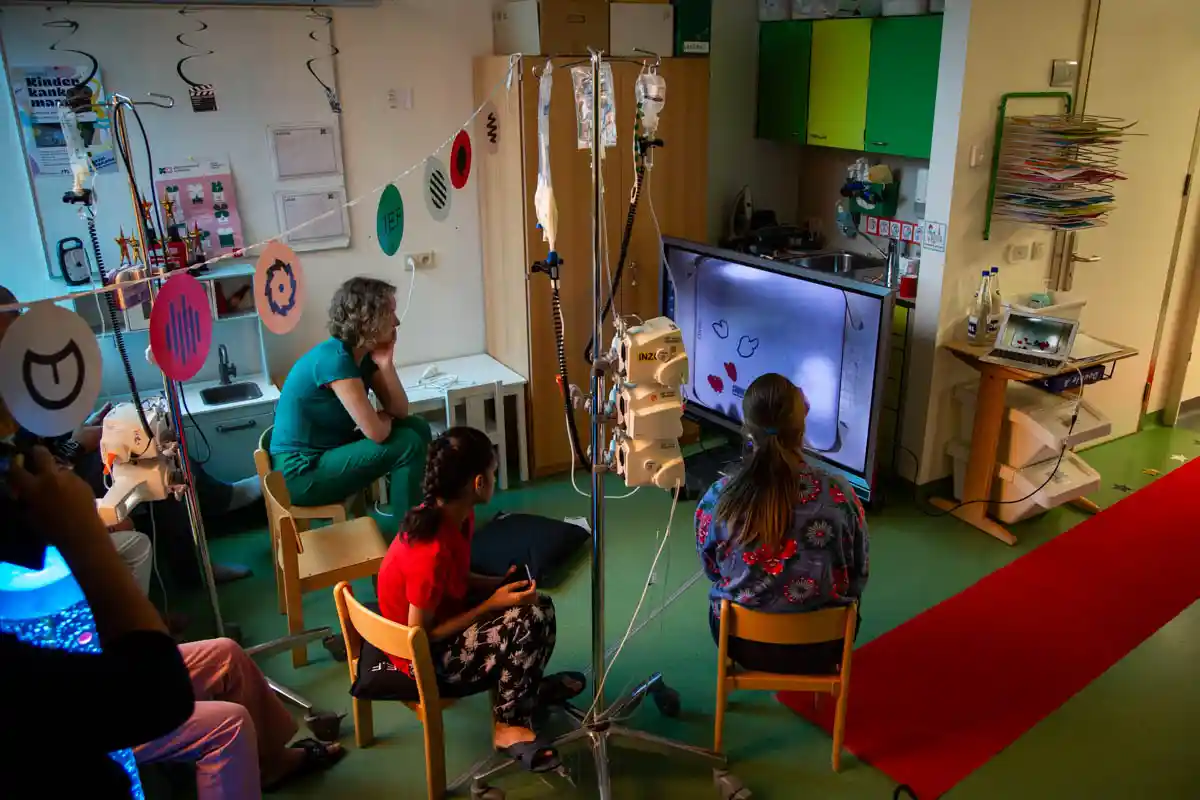
The platform aims to provide children who are physically limited in their access to festivals or cinemas with a unique experience. Together with hospitals and rehabilitation centers, the involved organizations want to reach as many children as possible. According to Iris Verhoeven, “the project now reaches between 100 and 150 hospitals, although quality remains more important than quantity”. Furthermore, she claims that “it's not just about making films available, but also about encouraging creative engagement”. According to Ferdinand Lewis from Arts in Health Netherlands, this is essential for the children's recovery. "It doesn't take away the pain, but a positive attitude can certainly promote recovery", he explains in a video about the Film in Hospital project. "In this way, healthcare also becomes more human." Staff at participating hospitals can support the project without taking up too much of their time, allowing them to focus fully on their care responsibilities. However, Iris Verhoeven says that organizing it all is not so simple. Feedback from both healthcare providers and parents is essential, so that the initiative not only continues to grow, but also keeps improving. For example, JEF learned not to use colors that evoke associations with chemotherapy. “A small adjustment, but it makes a huge difference for the children”, states Loes Welkenhuysen of JEF.
A great diverse, accessible, and interactive offering
The Film in Hospital project focuses on a wide range of age groups and ensures that the content is suitable for every child, regardless of how ill they are. Children can enjoy a wide range of films, with as many as 80 short films and a lot of feature films, which are updated every year. Interactivity plays a big role in this: children can vote, play games, and share stories with fellow patients from the participating countries (Spain, Belgium, Germany, Slovenia, Croatia, Greece, Italy, and Sweden). Furthermore, each year the exclusive short films in competition of the Youth Film Festival in Antwerp are distributed on the platform. Children can rate films, give stars, and even take on the role of film jury. In this way, the platform becomes not only an enjoyable experience but also a valuable addition to commercial VOD platforms. Through this platform, children get the chance to share their creativity and stories, thereby making their own valuable contribution to the world of film.
Impact on the industry, but most importantly on our future
This particular project demonstrates that European collaborations are not only possible but also desirable and can have a significant positive impact on society. “The social impact you have with youth films is immense, as they are the future and deserve our care”, Iris Verhoeven argues. Moreover, the Film in Hospital project involves a new generation of young viewers for European films, which can only benefit the future of the European film industry.
Author:
Bjarni Vanhoutte is a Communication Sciences student Film and Television studies at Ghent University, currently finalising his master’s studies. During his internship, he was part of the Centre for Cinema and Media Studies (CIMS), where he conducted research on the European H2020-project “Reviving, Boosting, Optimising, and Transforming European Film Competitiveness (REBOOT)”.
Jens Van Landschoot obtained a master’s degree in Communication Sciences from Ghent University, specializing in Film and Television studies. During his Master’s thesis, he explored the differences between the Flemish film industry and Hollywood. Starting from January 2025, he takes part in the European H2020-project "Reviving, Boosting, Optimising, and Transforming European Film Competitiveness (REBOOT)". This project aims to connect current strengths, address weaknesses, and strategize for future competitiveness across policy, practice, and the overall experience within the European Film Industry.
Daniël Biltereyst is a Full Professor in Film and Media Studies at Ghent University, Belgium. He is the Director of the Centre for Cinema and Media Studies (CIMS), an elected member of the Academia Europaea, and linked to the HoMER network. His work focuses on film and media history, cultural media studies, and various projects related to cinema history and censorship. He recently published Cinema in the Arab World (2023, with I. Elsaket and Ph. Meers), and co- edited a theme issue on European cinema for the film and media studies journal Cinéma & cie (with E. Gipponi and A. Miconi, 2023).