European Cinema: Crisis or Resilience? Reflections from the Frames of Change Conference
In her keynote, entitled Half Full: Positive Conceptions of European Cinema, Mariana Liz (University of Lisbon, Portugal) urged attendees to move beyond binary thinking and embrace the complexity of European cinema. She argued that instead of asking whether European cinema is in crisis or thriving, we should explore the nuances that define its current state. Or, as she put it: “We need to stop framing European cinema in terms of decline or success. It’s a field shaped by contradictions, and that’s precisely what makes it so rich and worth studying.”
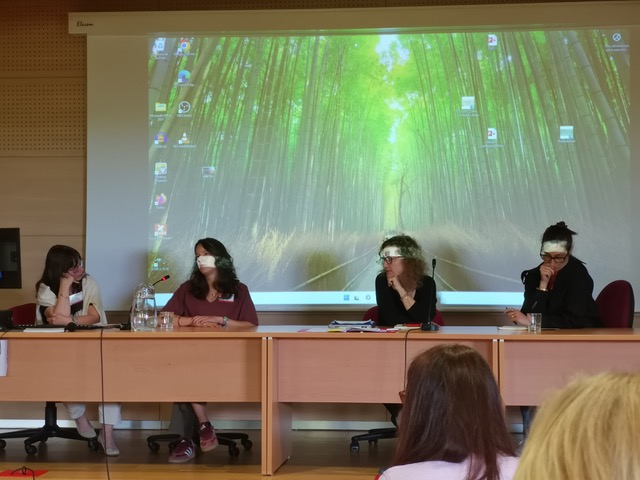
To offer more insights into these themes, the exchanges were conducted with insightful participantsom different fields of expertise: Melis Behlil (Kadir Has University, Turkey), Christopher Meir (Universidad Carlos III de Madrid, Spain) and Marina Rossato Fernandes (Université de Liège, Belgium). Their reflections offer a multifaceted view of the challenges and opportunities facing European cinema today.
Crisis as a Constant?
Quizzed on whether European cinema is in crisis, Liz responded with a historical perspective: “There are many problems in European cinema. But I think the issue has more to do with the tense of the verb. European cinema has always been in crisis. So, I think we should start from a different premise, which is to say there have always been challenges, but we’ve always kind of made it.”
Christopher Meir echoed this sentiment, pointing out that while European arthouse cinema is often seen as declining, it continues to renew itself and play a significant role globally: “Even the weakest European industries still get 20 to 30% of their local box office. That’s valuable. And we shouldn’t forget the strength of popular cinema across Europe, even if it’s fragmented along national lines.”
One of the recurring themes at the conference was the transnational circulation of films. Melis Behlil emphasized the importance of recognizing how films travel across borders, especially in the age of streaming: “We don’t always remember the transnational nature of cinema and all its aspects, especially in terms of the audience. Films always travelled, but now they travel even more with platforms. And it’s always good to keep that in mind that there are no clear borders or clear separations between European and non-European films. In so many cases, there is some kind of connection.”
Streaming platforms, in particular, have reshaped how European films reach audiences. Meir sees this as a major opportunity: “Streaming is really a much better opportunity than Europeans realize. What you’re seeing from Netflix’s original European films and the audiences they reach, this is a template that Europeans really got to get their heads around. (...) From different parts of Europe, the numbers are very exciting. This is an opportunity. And so, European producers and distributors have to find ways to benefit from those formulas, whether that is releasing those kinds of films in theatres and testing the waters for action films, horror films and romantic melodramas, or working with the platforms to reach those audiences and keep those films in the lives of Europeans and filmgoers worldwide.”
Behlil offered a broader view of the global media ecosystem, highlighting the immense power of streaming platforms: “You’re talking about some of the biggest private companies in the world. Netflix, Amazon, Apple—they’re not just media companies, they’re data and AI giants. Their influence goes far beyond content.”
Challenges and Opportunities Ahead
Looking forward, the panellists identified several pressing challenges and emerging opportunities. Behlil addressed the growing concern around artificial intelligence: “Everyone is still very concerned with AI. But looking at what AI has been producing in terms of text, I’m getting less and less worried because there really isn’t any spark in that. And I think people can tell. So, while AI is indeed a challenge, I think the worry and panic around it might be more of a challenge than the actual risk for AI. I really hope I won’t be proven wrong about this.”
Liz focused on audience engagement and the communal experience of cinema: “Definitely another challenge is going to be how you either maintain or bring audiences back to the theatres. Also how you engage young audiences in traditional viewing practices. There are group viewing practices that have to do with community and commonality and the collective experience of watching films that are being lost. My keynote was all about being positive, and I think there are opportunities in terms of emerging talent, that there are a lot of new players coming in and we need to hold on to those positive signs. There are also films that have been surprisingly more engaging than anticipated.”
Marina Rossato Fernandes highlighted the financial pressures and the need for creative freedom: “I think one of the main challenges is the financialization of the sector and this pressure to be more competitive. And also the reliance on international players that have a purely economic approach to the film. Because this will inevitably influence the content produced and consequently the values that it carries. And I think in terms of opportunities I believe that there is more room for experimentation in terms of narratives, in terms of financing and producing the content, but also in terms of connecting with the audience.”
Rethinking Competitiveness and Embracing Complexity
Another issue, which was central to the REBOOT-project, was the competitiveness of the European film industry. On this topic, Rossato Fernandes offered a compelling redefinition of competitiveness in the European film context: “There is a growing pressure for the European film industry to become more competitive. This is coming mainly from a top-down approach, from some policy discourse. But the metrics that professionals use to assess competitiveness are international recognition in awards, participation in film festivals, and even the capacity to produce diverse content. There are not only economic metrics in terms of market share. And what film professionals really value in terms of competitiveness is much closer to the cultural value of the film than the economic perspectives.”
The Frames of Change conference offered a timely reminder that European cinema cannot be understood through simple binaries around usual notions of competitiveness. It is a field shaped by contradictions between national and transnational, popular and arthouse, economic and cultural. As Mariana Liz suggested, perhaps the most productive way forward is to embrace these complexities and build visions that reflect the richness of European cinema. Whether through policy, scholarship, or creative practice, the challenge is not just to survive but to reimagine what European cinema can be.
Author: Daniël Biltereyst is a Full Professor in Film and Media Studies at Ghent University, Belgium. He is the Director of the Centre for Cinema and Media Studies (CIMS), an elected member of the Academia Europaea, and linked to the HoMER network. His work focuses on film and media history, cultural media studies, and various projects related to cinema history and censorship. He recently published Cinema in the Arab World (2023, with I. Elsaket and Ph. Meers), and coedited a theme issue on European cinema for the film and media studies journal Cinéma & cie (with E. Gipponi and A. Miconi, 2023).
Fernando Ramos Arenas is Associate Professor of European Cinema History at the Department of Art History at Complutense University in Madrid, where he is also Key Staff Member of the Jean Monnet Chair Modern Times: European Audiovisual Heritage in an era of Transformation. From 2010 to 2017 he was assistant professor at Leipzig University, Germany, where he earned his Ph.D. in 2010 and his habilitation in 2020. He was Marie Curie fellow and in 2017-18 he was visiting researcher at Georgetown University, Washington DC. Since 2022 he is the editor in chief of the journal Anales de Historia del Arte. His research focuses on European film culture, national cinemas and film heritage. He has published two monographs on European cinema (on authorship, 2011, and cinephilia, 2021), edited three volumes and written articles in leading research journals such as Screen,Medien & Kommunikationswissenschaft, Media History, Hispanic Research Journaland Journal of Spanish Cultural Studies.
Jens Van Landschoot obtained a master’s degree in Communication Sciences from Ghent University, specializing in Film and Television studies. During his Master’s thesis, he explored the differences between the Flemish film industry and Hollywood. Starting from January 2025, he takes part in the European H2020-project "Reviving, Boosting, Optimising, and Transforming European Film Competitiveness (REBOOT)". This project aims to connect current strengths, address weaknesses, and strategize for future competitiveness across policy, practice, and the overall experience within the European Film Industry.