Discussing Heritage Meanings of European Film at the ELABCHROM Conference
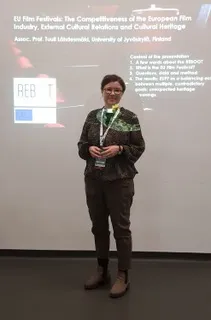
European film is not only an important European industry, but also an essential part of Europe's cultural heritage and, as such, could be promoted more effectively to reach audiences who want to engage with it. This is the argument presented by Tuuli Lähdesmäki at the conference Tangible and Intangible Cultural Heritage: A Dichotomy under Debate, held on 24-25 October in Sibiu, Romania. The conference was organised by the Horizon Europe- funded ELABCHROM project with its project partners, the Lucian Blaga University Sibiu in Romania, the University of Burgundy in France, and the University of Jyväskylä in Finland.
The conference brought together over 70 experts from different European countries, representing not only universities and research institutes, but also museums and cultural institutions. In 14 thematic panels, speakers and participants discussed the intertwining of tangible and intangible cultural heritage and the challenges of distinguishing them in cultural policy and governance. One of the conference panels focused on festivals as cultural heritage. This theme linked the conference to the local cultural scene in Sibiu, known for its lively international festivals. During the conference, the city hosted the Astra Film Festival (https://www.astrafilm.ro/en), which has been held annually in Sibiu since 1993. It is known for presenting a diverse selection of documentaries from around the world.
Lähdesmäki's presentation at the conference focused on the EU Film Festivals that the REBOOT partners from the University of Jyväskylä, Erasmus University Rotterdam (the Netherlands), and Kadir Has University (Türkiye) have jointly researched based on grey literature and interview data collected among EU Delegations and EU Film Festival organisers in eight non-EU countries. Lähdesmäki's presentation focused on EU Film Festivals in two case countries, the UK and Canada, both of which include populations, migrants, and ex-patriots with heritage and cultural roots in (continental) Europe.
The analysis of this interview data showed that European films have a particular heritage meaning that is not addressed in EU film policy. This meaning is based on film as personal cultural heritage, i.e. historical, cultural, and familial elements that shape one's identity and sense of belonging to a cultural group. According to the interviews with festival organisers, European expatriates, migrants and citizens with a migrant background and their families form an important audience for festivals in multicultural metropolises, such as London, Toronto, Ottawa, and Vancouver. Such audiences are eager to see European films from their (or their parents', grandparents' or relatives') home countries, to experience their culture and cultural environment and to hear their native language.
Since 2000, EU cultural policy discourses have identified film as cultural heritage and launched policies to promote European film heritage. Film as heritage is also mentioned in practical guidelines for EU Film Festivals. However, neither the policies nor the guidelines recognise the personal heritage meaning of European films. Such a meaning is important for a specific audience segment, which could be better recognised as a potential market niche for European films.
Tuuli Lähdesmäki
University of Jyväskylä
The conference brought together over 70 experts from different European countries, representing not only universities and research institutes, but also museums and cultural institutions. In 14 thematic panels, speakers and participants discussed the intertwining of tangible and intangible cultural heritage and the challenges of distinguishing them in cultural policy and governance. One of the conference panels focused on festivals as cultural heritage. This theme linked the conference to the local cultural scene in Sibiu, known for its lively international festivals. During the conference, the city hosted the Astra Film Festival (https://www.astrafilm.ro/en), which has been held annually in Sibiu since 1993. It is known for presenting a diverse selection of documentaries from around the world.
Lähdesmäki's presentation at the conference focused on the EU Film Festivals that the REBOOT partners from the University of Jyväskylä, Erasmus University Rotterdam (the Netherlands), and Kadir Has University (Türkiye) have jointly researched based on grey literature and interview data collected among EU Delegations and EU Film Festival organisers in eight non-EU countries. Lähdesmäki's presentation focused on EU Film Festivals in two case countries, the UK and Canada, both of which include populations, migrants, and ex-patriots with heritage and cultural roots in (continental) Europe.
The analysis of this interview data showed that European films have a particular heritage meaning that is not addressed in EU film policy. This meaning is based on film as personal cultural heritage, i.e. historical, cultural, and familial elements that shape one's identity and sense of belonging to a cultural group. According to the interviews with festival organisers, European expatriates, migrants and citizens with a migrant background and their families form an important audience for festivals in multicultural metropolises, such as London, Toronto, Ottawa, and Vancouver. Such audiences are eager to see European films from their (or their parents', grandparents' or relatives') home countries, to experience their culture and cultural environment and to hear their native language.
Since 2000, EU cultural policy discourses have identified film as cultural heritage and launched policies to promote European film heritage. Film as heritage is also mentioned in practical guidelines for EU Film Festivals. However, neither the policies nor the guidelines recognise the personal heritage meaning of European films. Such a meaning is important for a specific audience segment, which could be better recognised as a potential market niche for European films.
Tuuli Lähdesmäki
University of Jyväskylä