The Reboot Project at Málaga Film Festival 2025 (MAFIZ)
A VOD Europe report analyzes the competitiveness of European cinema on digital platforms
The VOD Europe Report -Case Study of Spain was presented at the Málaga Film Festival (MAFIZ) on March 18, 2025. Developed within the Horizon 2020 REBOOT Project, funded by the European Union under the Horizon Europe program, this study was led by Dr. Fernando Ramos in collaboration with Dr. Loreto Corredoira from Complutense University of Madrid. It examines the evolution and key challenges of the Video on Demand (VOD) market in Spain and across Europe.
The report examines the impact of major global platforms such as Netflix, Amazon Prime Video, and MAX, as well as the response of national operators such as Filmin and Atresplayer. Among its key findings, it highlights the positive effects of the implementation of the Audiovisual Media Services Directive (AVMSD 2018) in Spanish legislation through the General Law on Audiovisual Communication (LGCA, 2022), which establishes requirements for the promotion and funding of European content.
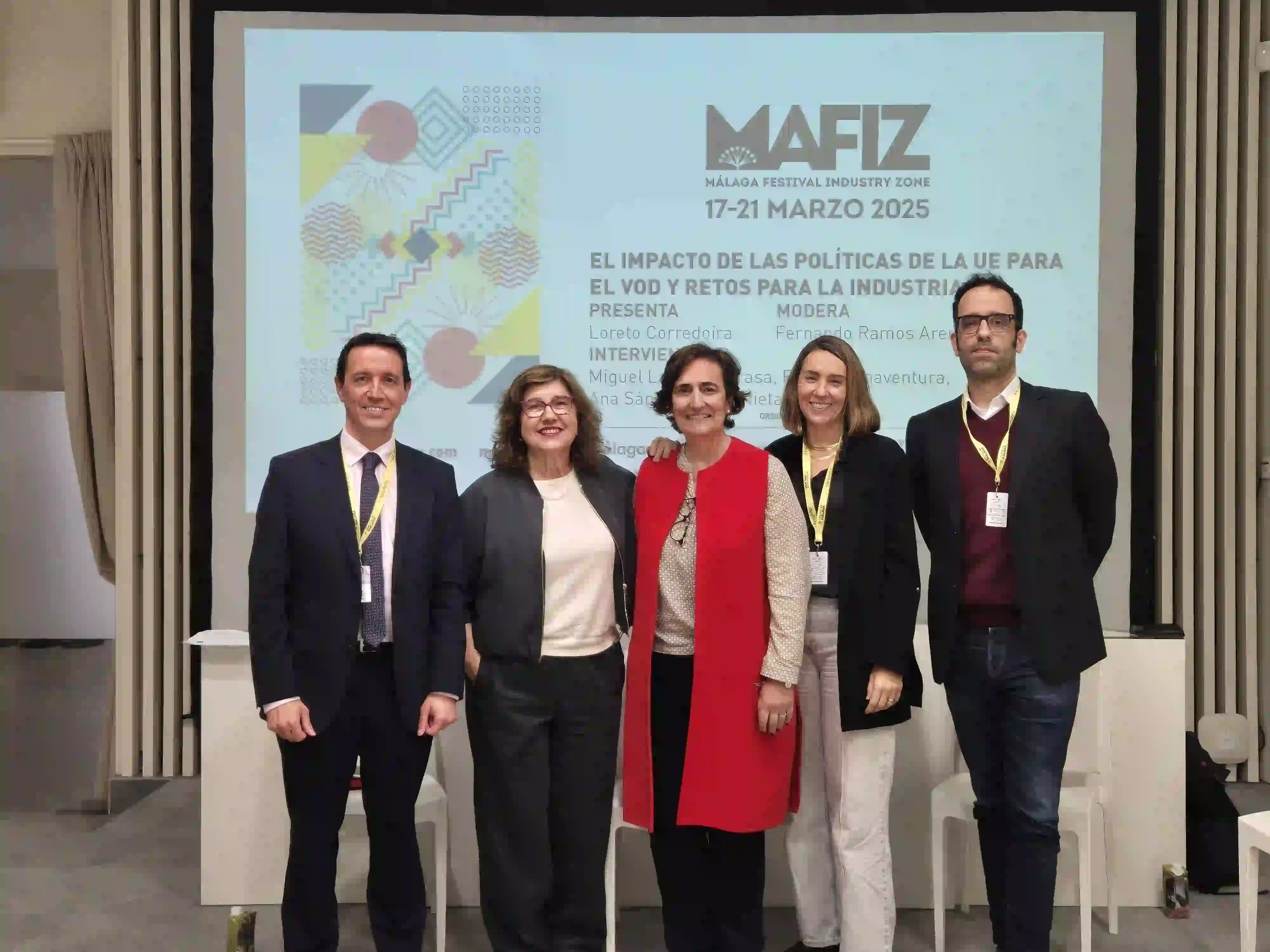
Alongside the presentation, a panel discussion was held, moderated by Fernando Ramos, with Fabia Buenaventura, General Director of Independent Producers (FAPE), who called for continued support for Spanish and European cinema, considering that the sector is fragmented by SMEs and medium-sized businesses. Miguel Langle, Director of Regulatory Affairs and Institutional Relations of Atresmedia, suggested that, in the future, the Directive should apply the same legal framework to all audiovisual players and not only television and VOD (video-sharing platforms such as YouTube and Instagram). Finally, journalist and film critic Ana Sánchez de la Nieta (Aceprensa, Row 7) talked about the creative period Spanish cinema is coming through and pointed out that the financial support has been effective and has led to films such as Sorda, a film by Eva Libertad that is tipped to be a favorite in Málaga Film Festival, with a fresh approach to disability and motherhood, a kind of movie that make us better as a society.
The VOD Europe Report -Case Study of Spain was presented at the Málaga Film Festival (MAFIZ) on March 18, 2025. Developed within the Horizon 2020 REBOOT Project, funded by the European Union under the Horizon Europe program, this study was led by Dr. Fernando Ramos in collaboration with Dr. Loreto Corredoira from Complutense University of Madrid. It examines the evolution and key challenges of the Video on Demand (VOD) market in Spain and across Europe.
The report examines the impact of major global platforms such as Netflix, Amazon Prime Video, and MAX, as well as the response of national operators such as Filmin and Atresplayer. Among its key findings, it highlights the positive effects of the implementation of the Audiovisual Media Services Directive (AVMSD 2018) in Spanish legislation through the General Law on Audiovisual Communication (LGCA, 2022), which establishes requirements for the promotion and funding of European content.
Alongside the presentation, a panel discussion was held, moderated by Fernando Ramos, with Fabia Buenaventura, General Director of Independent Producers (FAPE), who called for continued support for Spanish and European cinema, considering that the sector is fragmented by SMEs and medium-sized businesses. Miguel Langle, Director of Regulatory Affairs and Institutional Relations of Atresmedia, suggested that, in the future, the Directive should apply the same legal framework to all audiovisual players and not only television and VOD (video-sharing platforms such as YouTube and Instagram). Finally, journalist and film critic Ana Sánchez de la Nieta (Aceprensa, Row 7) talked about the creative period Spanish cinema is coming through and pointed out that the financial support has been effective and has led to films such as Sorda, a film by Eva Libertad that is tipped to be a favorite in Málaga Film Festival, with a fresh approach to disability and motherhood, a kind of movie that make us better as a society.
The VOD market in Spain and its regulation
The study reveals how the arrival of major international platforms starting in 2015 with Netflix has transformed the Spanish audiovisual ecosystem, generating significant changes in the production, distribution, and consumption of European films. The year 2020 was especially important due to the "shutdown" resulting from COVID-19, which increased the consumption of streaming content. Disney+ took advantage of the opportunity to launch its service globally.
The report focuses on three VOD cases in Spain, from the arrival or launch of MAX (in 2016 under the HBO brand), Filmin (in 2008), and Atresplayer in 2019 with the Premium option, to the maturity or consolidation of these applications in the market. These are three distinct models for offering films, series, documentaries, and animation.
The level of compliance with the obligations to promote European audiovisual works has been analyzed. Filmin, for example, leads the offer of European content, with 61% of its catalog including European works, which is his hallmark. MAX also meets this requirement thanks to its parent company's catalog, as HBO was acquired by WarnerMedia in 2021 and merged with Discovery+ in 2023. Atresplayer, for its part, being part of the Atresmedia audiovisual group, which invests in its own and third-party productions, also exceeds the production quota requirements (50-60% of its catalog of European works are audiovisual works, mainly series).
Furthermore, the report highlights the importance of regulatory policies that require platforms to invest a percentage of their revenue in financing European productions, purchasing rights, or contributing to Film Funds. As a result, in 2024, Netflix allocated €68 million to this purpose, while Atresmedia and Filmin invested €94.9 million and €1.5 million respectively (all according to data from the National Commission on Markets and Competition (CNMC).
Recommendations and perspectives
The report recommends strengthening the role of the National Commission on Markets and Competition (CNMC) in supervising VOD platforms, improving transparency in the reporting of data on the production of European content as well as regarding audience measurement (a current lack of transparency due to the variety of services), and strengthening investment obligations in the European film industry. It also advocates for greater diversification of the content offer in order to ensure the sector's cultural diversity and competitiveness.
The abridged version of the report in Spanish is available for download here .
The full report in English is available at this link and on the official REBOOT project platforms.
The study reveals how the arrival of major international platforms starting in 2015 with Netflix has transformed the Spanish audiovisual ecosystem, generating significant changes in the production, distribution, and consumption of European films. The year 2020 was especially important due to the "shutdown" resulting from COVID-19, which increased the consumption of streaming content. Disney+ took advantage of the opportunity to launch its service globally.
The report focuses on three VOD cases in Spain, from the arrival or launch of MAX (in 2016 under the HBO brand), Filmin (in 2008), and Atresplayer in 2019 with the Premium option, to the maturity or consolidation of these applications in the market. These are three distinct models for offering films, series, documentaries, and animation.
The level of compliance with the obligations to promote European audiovisual works has been analyzed. Filmin, for example, leads the offer of European content, with 61% of its catalog including European works, which is his hallmark. MAX also meets this requirement thanks to its parent company's catalog, as HBO was acquired by WarnerMedia in 2021 and merged with Discovery+ in 2023. Atresplayer, for its part, being part of the Atresmedia audiovisual group, which invests in its own and third-party productions, also exceeds the production quota requirements (50-60% of its catalog of European works are audiovisual works, mainly series).
Furthermore, the report highlights the importance of regulatory policies that require platforms to invest a percentage of their revenue in financing European productions, purchasing rights, or contributing to Film Funds. As a result, in 2024, Netflix allocated €68 million to this purpose, while Atresmedia and Filmin invested €94.9 million and €1.5 million respectively (all according to data from the National Commission on Markets and Competition (CNMC).
Recommendations and perspectives
The report recommends strengthening the role of the National Commission on Markets and Competition (CNMC) in supervising VOD platforms, improving transparency in the reporting of data on the production of European content as well as regarding audience measurement (a current lack of transparency due to the variety of services), and strengthening investment obligations in the European film industry. It also advocates for greater diversification of the content offer in order to ensure the sector's cultural diversity and competitiveness.
The abridged version of the report in Spanish is available for download here .
The full report in English is available at this link and on the official REBOOT project platforms.