Rethinking the Global Film Landscape: REBOOT at IFFR Pro Dialogue 2024
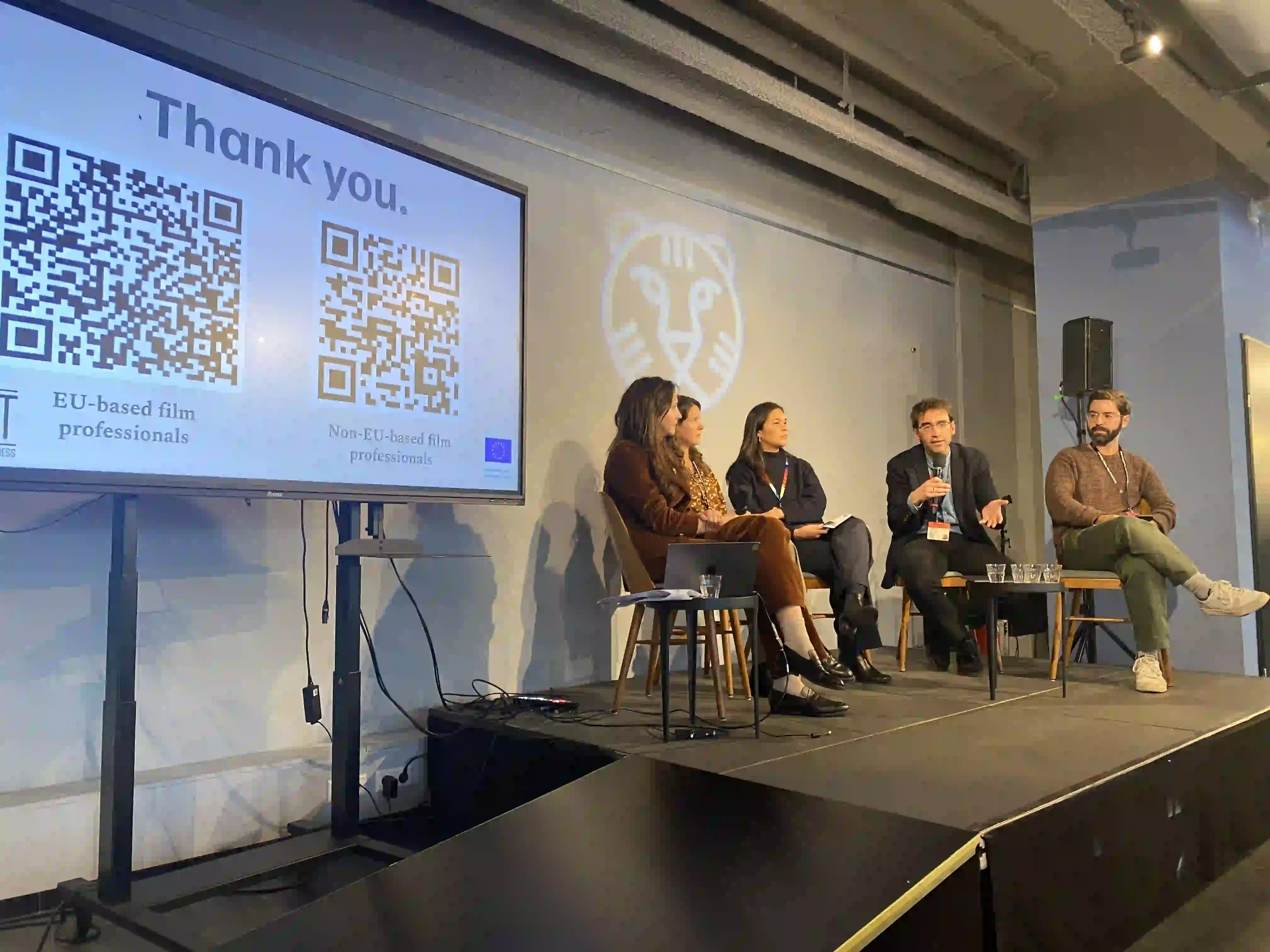
How competitive is European cinema really and at what cost? In an era where EU policymakers are doubling down on the word competitiveness, the REBOOT Project brought this question to the fore in a panel titled “Global Film Europe: Rethinking Competitiveness, Identity, and Power.” The event wove together research insights, fieldwork, and a deeply human reflection on the position of European cinema within the shifting dynamics of the global film industry.
Moderated by Pedro Tinen, German Chancellor Fellow of the Alexander von Humboldt Foundation, the session invited a compelling lineup of speakers: Dr. Mafalda Dâmaso (Erasmus University Rotterdam), Prof. Antonios Vlassis and Dr. Marina Rossato Fernandes (both from the University of Liège), and Isabela Morena Vargas Miranda (University Carlos III of Madrid). Together, they presented new data, fresh analysis, and urgent calls for reimagining the rules of cinematic engagement between Europe and the world. The panel opened with a crisp overview of the REBOOT Project by Prof. Vlassis and Dr. Dâmaso, setting the stage for three key presentations, each probing a different dimension of the European film industry’s global footprint.
At the heart of the conversation was a shared critique: that the dominant market-driven understanding of “competitiveness” in European film policy is not only narrow but increasingly disconnected from the realities on the ground.
Rossato Fernandes and Prof. Vlassis shared findings from a pan-European survey and 37 in-depth interviews with EU-based professionals. The results revealed a complex picture, while European film is often praised for its artistic credibility and diverse storytelling, there is growing frustration with fragmented promotional strategies, limited access to global markets, and structural underinvestment. Next, Dr. Dâmaso turned the spotlight northward to examine the co-production ecosystems in Denmark and Sweden, drawing on interviews with 15 professionals. She highlighted how strategic policy frameworks, such as streaming levies and support across the entire value chain, contribute to a fertile environment for making globally competitive films. “What stands out is the emphasis on cultural pluralism, long-term investment, and policy mechanisms that redistribute value back into the local industries,” she explained.
The final presentation widened the lens even further, investigating how European cinema is perceived by professionals in South Korea, South Africa, Argentina, Brazil, Mexico, and Turkey. Co-authored by Dâmaso, Vargas Miranda, Rossato Fernandes, and Vlassis, the research blended survey and qualitative fieldwork. The findings pointed to a duality: on the one hand, admiration for Europe’s cinematic heritage; on the other, skepticism about the inclusiveness and reciprocity of current cooperation frameworks.
Throughout the session, the audience was drawn into a conversation that transcended statistics and strategies. It became clear that the future of European film is not simply a matter of competing harder, it’s about reimagining the terms of competition altogether. This means embracing complexity, rebalancing power, and building new narratives of cooperation, equity, and creative freedom.
Read more here
Moderated by Pedro Tinen, German Chancellor Fellow of the Alexander von Humboldt Foundation, the session invited a compelling lineup of speakers: Dr. Mafalda Dâmaso (Erasmus University Rotterdam), Prof. Antonios Vlassis and Dr. Marina Rossato Fernandes (both from the University of Liège), and Isabela Morena Vargas Miranda (University Carlos III of Madrid). Together, they presented new data, fresh analysis, and urgent calls for reimagining the rules of cinematic engagement between Europe and the world. The panel opened with a crisp overview of the REBOOT Project by Prof. Vlassis and Dr. Dâmaso, setting the stage for three key presentations, each probing a different dimension of the European film industry’s global footprint.
At the heart of the conversation was a shared critique: that the dominant market-driven understanding of “competitiveness” in European film policy is not only narrow but increasingly disconnected from the realities on the ground.
Rossato Fernandes and Prof. Vlassis shared findings from a pan-European survey and 37 in-depth interviews with EU-based professionals. The results revealed a complex picture, while European film is often praised for its artistic credibility and diverse storytelling, there is growing frustration with fragmented promotional strategies, limited access to global markets, and structural underinvestment. Next, Dr. Dâmaso turned the spotlight northward to examine the co-production ecosystems in Denmark and Sweden, drawing on interviews with 15 professionals. She highlighted how strategic policy frameworks, such as streaming levies and support across the entire value chain, contribute to a fertile environment for making globally competitive films. “What stands out is the emphasis on cultural pluralism, long-term investment, and policy mechanisms that redistribute value back into the local industries,” she explained.
The final presentation widened the lens even further, investigating how European cinema is perceived by professionals in South Korea, South Africa, Argentina, Brazil, Mexico, and Turkey. Co-authored by Dâmaso, Vargas Miranda, Rossato Fernandes, and Vlassis, the research blended survey and qualitative fieldwork. The findings pointed to a duality: on the one hand, admiration for Europe’s cinematic heritage; on the other, skepticism about the inclusiveness and reciprocity of current cooperation frameworks.
Throughout the session, the audience was drawn into a conversation that transcended statistics and strategies. It became clear that the future of European film is not simply a matter of competing harder, it’s about reimagining the terms of competition altogether. This means embracing complexity, rebalancing power, and building new narratives of cooperation, equity, and creative freedom.
Read more here