“Meetings on the Bridge”: Rethinking European cooperation, copyright and competitiveness at Istanbul Film Festival
The current EU legal regime, though comprehensive, continues to suffer from a lack of harmonisation, particularly around the definition of authorship and the complex web of terms and systems governing the use of content in ‘secondary Windows’ such as Video-on-Demand and other online platforms. Added to this are systemic challenges including unstable exchange rates, bureaucratic inefficiencies, and politicized domestic support structures, all of which were highlighted as major obstacles for filmmakers. Moreover, cultural and communication barriers often complicate co-production partnerships. Professionals voice a clear call for more flexible and adaptive policy frameworks, particularly in light of recent reforms introduced by Eurimages, and urged for revisions to minimum spending requirements, which currently hinder many from participating in international co- productions. These were among the most discussed issues at the 20th edition of “Meetings on the Bridge,” the industry platform of the Istanbul Film Festival.
On 15 April 2025, the REBOOT Project was presented by researchers Melis Behlil (KHAS University), Pelin Turan (SSSA), Marina Rossato Fernandes, and Antonios Vlassis (ULiège). The event took place at Hope Alkazar, a former cinema turned cultural venue in central Istanbul, drawing filmmakers, producers, and researchers into a timely and critical discussion about the challenges shaping today’s European film industry.
Moderated by Yamaç Okur, a well-known Turkish producer with extensive experience in European co-productions, the session presented key findings from REBOOT’s ongoing research, which includes international surveys and interviews with film professionals from across and beyond Europe. The conversation navigated structural challenges, policy inconsistencies, copyright issues, and cross-border collaborations, framed through the perspectives of both EU and non-EU professionals.
Antonios Vlassis and Marina Rossato Fernandes shared insights from a pan-European survey and 37 expert interviews on how film professionals across the EU perceive the rise of AI and the growing influence of Video-on-Demand (VOD) platforms. The presentation explored both the opportunities and challenges professionals identify in engaging with these technologies—from enhanced creative tools and broader distribution channels to concerns about intellectual property, market concentration, and artistic autonomy. The findings highlight a critical need for policy frameworks that better reflect on-the-ground realities and support a sustainable, diverse European film ecosystem in the digital age.
On 15 April 2025, the REBOOT Project was presented by researchers Melis Behlil (KHAS University), Pelin Turan (SSSA), Marina Rossato Fernandes, and Antonios Vlassis (ULiège). The event took place at Hope Alkazar, a former cinema turned cultural venue in central Istanbul, drawing filmmakers, producers, and researchers into a timely and critical discussion about the challenges shaping today’s European film industry.
Moderated by Yamaç Okur, a well-known Turkish producer with extensive experience in European co-productions, the session presented key findings from REBOOT’s ongoing research, which includes international surveys and interviews with film professionals from across and beyond Europe. The conversation navigated structural challenges, policy inconsistencies, copyright issues, and cross-border collaborations, framed through the perspectives of both EU and non-EU professionals.
Antonios Vlassis and Marina Rossato Fernandes shared insights from a pan-European survey and 37 expert interviews on how film professionals across the EU perceive the rise of AI and the growing influence of Video-on-Demand (VOD) platforms. The presentation explored both the opportunities and challenges professionals identify in engaging with these technologies—from enhanced creative tools and broader distribution channels to concerns about intellectual property, market concentration, and artistic autonomy. The findings highlight a critical need for policy frameworks that better reflect on-the-ground realities and support a sustainable, diverse European film ecosystem in the digital age.
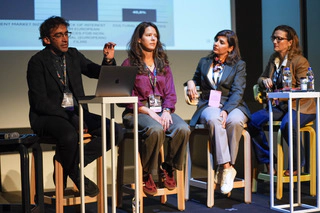
Moderator Okur talked about how competitiveness in the European film industry is not just about market presence but about access to networks, understanding legal frameworks, and finding spaces for collaboration across borders. Pelin Turan, researcher at Scuola Superiore Sant’Anna, delved into the copyright-related obstacles faced by independent and non-mainstream European producers, especially in distributing films internationally. Turan argues that technological advancements and the platformisation of content have opened new doors but these same developments raise complex questions about authorisation and rights clearance across multiple territories.
She emphasized that navigating this fragmented regulatory environment is particularly difficult for smaller players, noting: For many producers, it’s not only time-consuming and expensive, it also threatens their ability to bring films to global audiences.
To respond to these gaps, the REBOOT team is currently developing a set of best practices and coping strategies based on successful approaches adopted by film professionals who have managed to overcome such challenges. Following this, Melis Behlil of Kadir Has University presented insights on co-productions and the role of European Film Institutions (EFIs) from the perspective of Turkish filmmakers. She emphasized that many professionals see co-productions as crucial avenues for creative and financial support.
She explained that co-productions are seen as lifelines by many. They provide access to funding, feedback, networks, and international distribution, especially valuable for young filmmakers trying to break into the European scene.
However, Behlil also acknowledged the serious domestic and cross-cultural barriers that still persist. These include economic instability, limited institutional continuity, and difficulties working with international partners due to differing expectations and working styles. Nonetheless, she highlighted recent Eurimages practices that have helped address some of these issues, and echoed calls for more flexible policy mechanisms to respond to crises like the pandemic or other unpredictable events. Okur concluded that the panel attendees is not just studying problems but working with those in the field to co-create solutions that reflect the realities and aspirations of a diverse film community.”The REBOOT Project was part of the panel titled “REBOOT: Rethinking Competitiveness, Copyright and Film Cooperation,” as part of the festival’s “Cinema Talks” series.
She emphasized that navigating this fragmented regulatory environment is particularly difficult for smaller players, noting: For many producers, it’s not only time-consuming and expensive, it also threatens their ability to bring films to global audiences.
To respond to these gaps, the REBOOT team is currently developing a set of best practices and coping strategies based on successful approaches adopted by film professionals who have managed to overcome such challenges. Following this, Melis Behlil of Kadir Has University presented insights on co-productions and the role of European Film Institutions (EFIs) from the perspective of Turkish filmmakers. She emphasized that many professionals see co-productions as crucial avenues for creative and financial support.
She explained that co-productions are seen as lifelines by many. They provide access to funding, feedback, networks, and international distribution, especially valuable for young filmmakers trying to break into the European scene.
However, Behlil also acknowledged the serious domestic and cross-cultural barriers that still persist. These include economic instability, limited institutional continuity, and difficulties working with international partners due to differing expectations and working styles. Nonetheless, she highlighted recent Eurimages practices that have helped address some of these issues, and echoed calls for more flexible policy mechanisms to respond to crises like the pandemic or other unpredictable events. Okur concluded that the panel attendees is not just studying problems but working with those in the field to co-create solutions that reflect the realities and aspirations of a diverse film community.”The REBOOT Project was part of the panel titled “REBOOT: Rethinking Competitiveness, Copyright and Film Cooperation,” as part of the festival’s “Cinema Talks” series.