A system built to fail its filmmakers?
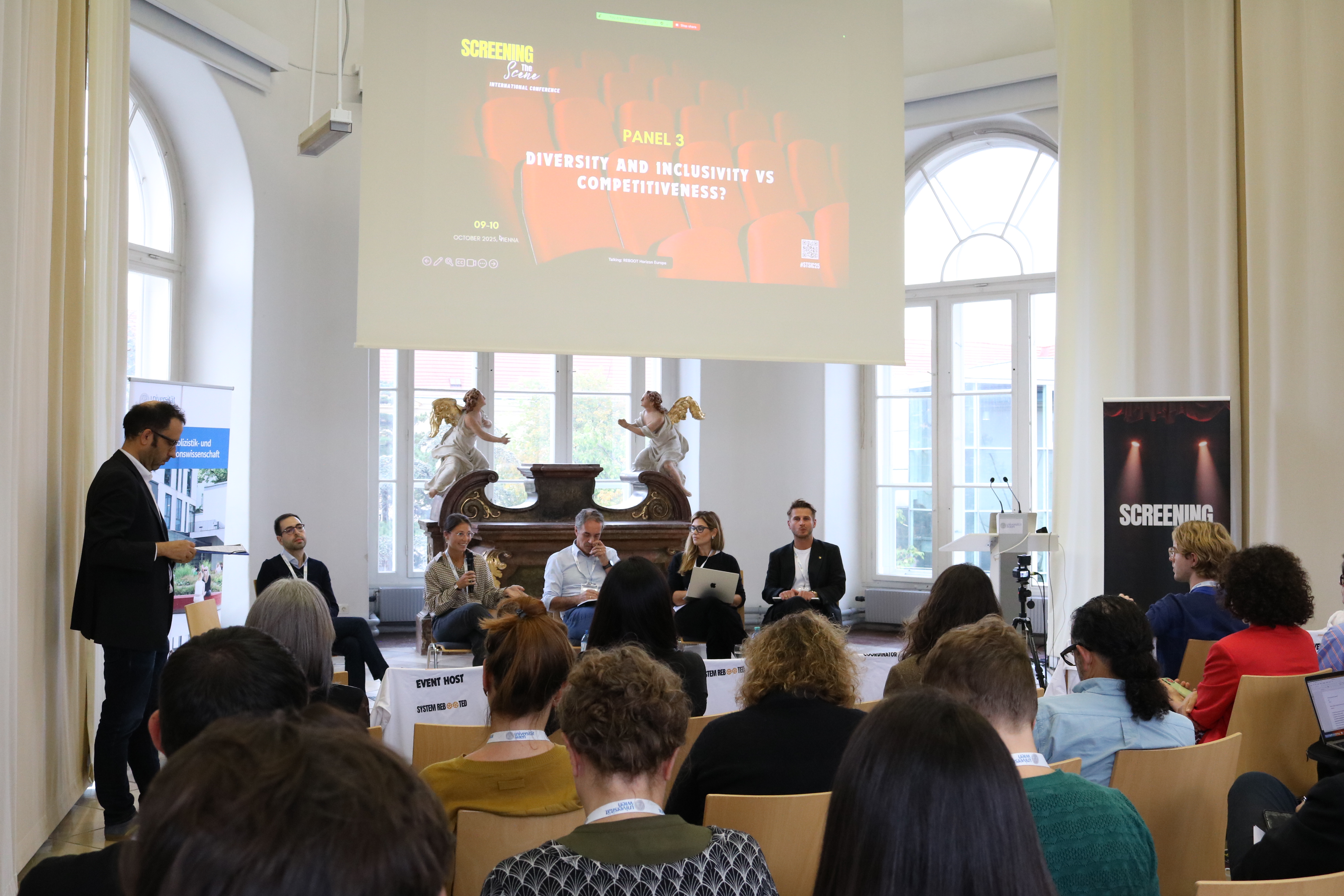
The REBOOT project hosted its closing conference in October 2025, bringing together more than 70 scholars from 19 nationalities and featuring 37 research presentations. Over two days, the event showcased the results of three years of collaborative work, during which researchers collected and analysed extensive data on the European film industry. The discussions that unfolded offered valuable insights and pointed to the profound tensions shaping the sector today.
From the outset, the conversation gravitated toward the growing disconnect between ambition and reality in European filmmaking. Speakers described contemporary pitching forums and film markets as “temples of illusions,” spaces built around the logic of capitalist exchange despite the diminishing availability of actual capital. This observation set the tone for a broader reflection on how creative aspirations are often welcomed into institutional spaces where financial foundations have quietly eroded.
The conference brought together academics, filmmakers, policymakers, and industry professionals for a critical exchange on the future of European cinema. With streaming platforms reshaping distribution, artificial intelligence transforming production workflows, and calls for diversity and inclusion becoming increasingly urgent, participants examined what competitiveness means for Europe’s cultural industries today.
The programme featured keynotes, policy discussions, and thematic panels exploring the intersections of people, technology, and institutions. Central themes included the position of European film in global markets, youth audiences and their evolving preferences, the challenges faced by those working at the fringes of the industry, the impact of streaming and AI and the legal and policy frameworks shaping Europe’s cultural sovereignty. Distinguished speakers and guests included Roland Teichmann, Director of the Austrian Film Institute (Austria) Juliette Prissard, General Delegate of Eurocinema (Belgium), Katharina Schenk, Head of Fiction, ORF Austrian Broadcasting Corporation (Austria) Rodrigo Gomez, Professor, Universidad Autónoma Metropolitana-Cuajimalpa (Mexico).
Under the leadership and moderation of Professor Katharine Sarikakis, Director of the Media Governance Lab and REBOOT Coordinator, the conference became a space for meaningful dialogue and collective reflection. It offered an opportunity for scholars and industry stakeholders to rethink how a more resilient and equitable future for European cinema might be imagined and built.
Throughout the sessions, one issue repeatedly surfaced; the sector offers almost no incentives for long-term thinking or audience development. Participants argued that this absence of strategic vision is not a minor administrative gap but a structural obstacle that restricts the industry’s capacity to adapt to social and technological change. In a system with limited encouragement for experimentation, sustainability, or community-building, European cinema risks reinforcing its own limitations.
This tension between aspiration and constraint was especially apparent in discussions on talent development. Drawing on examples from national mentorship programmes, participants noted that even well-designed initiatives can inadvertently discourage creative risk-taking. Young filmmakers often enter such programmes with bold ideas but quickly adjust their work to align with institutional expectations that reward safety and familiarity.
Questions of power and privilege featured prominently as well. Speakers underscored that access to funding continues to depend heavily on pre-existing networks, informal norms, and Eurocentric standards that determine who enters and who remains outside the industry. Film education was criticised for perpetuating closed circles, connecting primarily those already linked to the sector and thus limiting the diversity of voices represented on screen.
A particularly charged debate centred on regulation, financing, and creative freedom. Contrary to the perception that regulation restricts artistic expression, several participants emphasised that well-crafted frameworks can protect and empower creators, particularly those without financial safety nets. Pre-financing emerged as the most crucial mechanism where without it, creative risk becomes a privilege accessible only to those who can afford failure. Economic insecurity pushes young filmmakers toward self-censorship, encouraging them to produce content they believe will be “liked” rather than to explore innovative or challenging ideas.
In this light, regulation is not merely administrative, it becomes a tool for safeguarding artistic risk. Fair funding structures, equitable labour conditions, and transparent decision-making processes can shift the burden of uncertainty from individual creators to institutions better positioned to manage it.
As discussions came to a close, one central question resonated across the room; who will pre-finance the films of tomorrow, the films that might first emerge on digital platforms, outside traditional markets, so that creators have the freedom to take risks? This question amounted to a call for financial innovation and a rethinking of institutional responsibility within the European film ecosystem. Without new mechanisms to support risk at the earliest stages, the future of Europe’s cultural diversity and its global competitiveness remains uncertain.
In the end, the Reboot conference made one thing clear. The European film industry and its future will depend on whether institutions, funders, and policymakers are ready to rebuild systems that not only recognise the challenges of risk, inequality, and technological disruption, but actively work to overcome them.
Author: Gentiana Ramadani