Release of Film-Industry Competitiveness Dashboard: An interactive way to see the EFI.
The newly developed Film-Industry Competitiveness Dashboard is an innovative digital tool designed to help stakeholders, researchers, and policymakers better understand—and ultimately improve—the performance of Europe's screen industries. Accessible through the Reboot project website, the Dashboard provides open access to a rich collection of data, indicators, and analyses generated through extensive research carried out by the project's consortium partners. These include insights from Deliverable 2.4, which explores key paradoxes in the European film industry over the past three decades; Deliverable 3.6, which examines the institutional context shaping industry dynamics; and Deliverable 6.2, which presents socio-economic indicators of the European Film Industry (EFI).
Grounded in Michael Porter's Diamond Model (Porter, 1990), the Dashboard adopts a well-established economic framework and adapts it to the specific realities and complexities of the European film and media sectors. While Porter's model was originally designed to assess national competitive performance, its reinterpretation within this project enables users to explore the creative industries through a multidimensional and context-sensitive lens.
The Dashboard is organised into four interactive domains, each corresponding to one of the model's core determinants of competitiveness. Through a combination of qualitative and quantitative indicators, users can navigate the following areas:
Factor Conditions, which highlight the availability of skilled professionals, state-of-the-art facilities, technological infrastructure, and training ecosystems.
Demand Conditions, which assess audience behaviour, levels of sophistication, cultural diversity, and the overall scale and structure of film markets.
Related and Supporting Industries, examining how complementary sectors—including advertising, tourism, education, and technology—contribute to and benefit from audiovisual activity.
Firm Strategy, Structure, and Rivalry, which explores how companies innovate, collaborate, and compete within their local, national, and European environments.
Grounded in Michael Porter's Diamond Model (Porter, 1990), the Dashboard adopts a well-established economic framework and adapts it to the specific realities and complexities of the European film and media sectors. While Porter's model was originally designed to assess national competitive performance, its reinterpretation within this project enables users to explore the creative industries through a multidimensional and context-sensitive lens.
The Dashboard is organised into four interactive domains, each corresponding to one of the model's core determinants of competitiveness. Through a combination of qualitative and quantitative indicators, users can navigate the following areas:
Factor Conditions, which highlight the availability of skilled professionals, state-of-the-art facilities, technological infrastructure, and training ecosystems.
Demand Conditions, which assess audience behaviour, levels of sophistication, cultural diversity, and the overall scale and structure of film markets.
Related and Supporting Industries, examining how complementary sectors—including advertising, tourism, education, and technology—contribute to and benefit from audiovisual activity.
Firm Strategy, Structure, and Rivalry, which explores how companies innovate, collaborate, and compete within their local, national, and European environments.
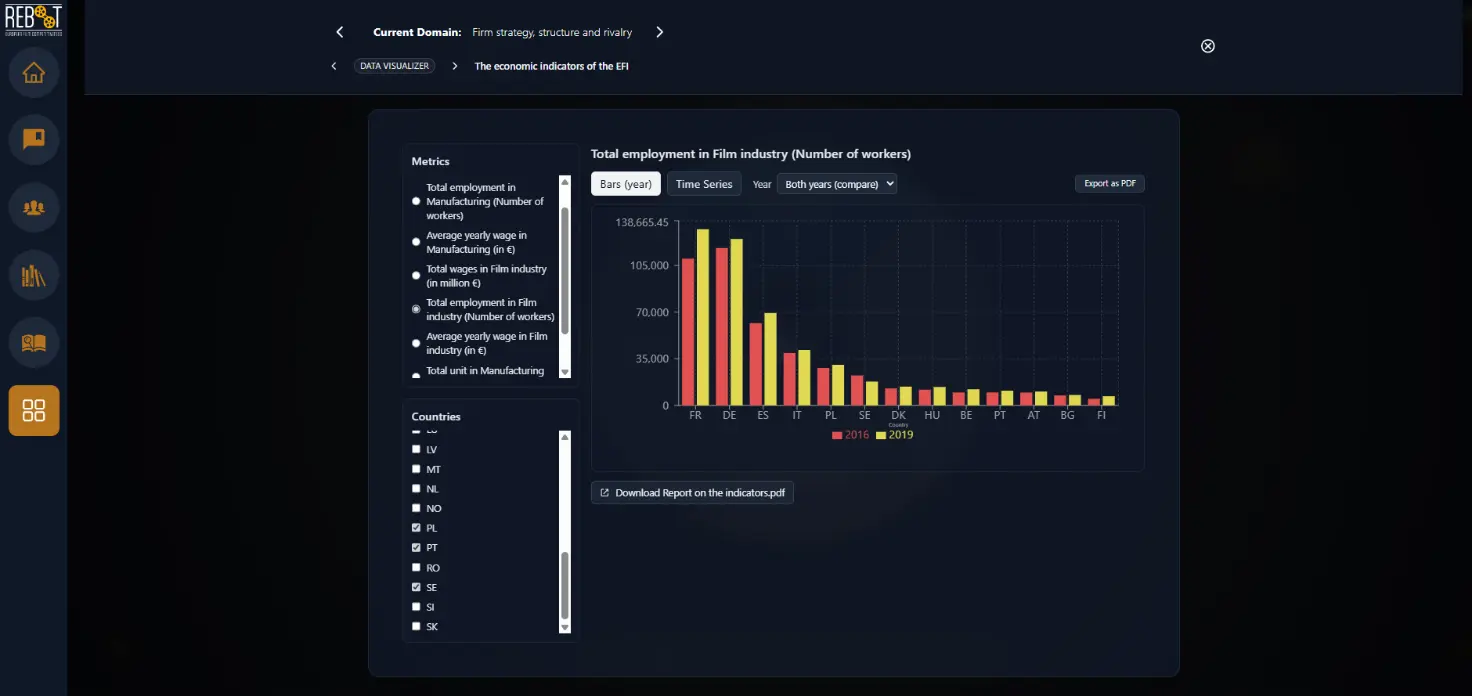
Reflecting the multidisciplinary nature of film-industry research, the Dashboard integrates data from legal, economic, sociological, and cultural perspectives. This approach builds on a strong academic foundation (Porter, 1998; Chapain & Comunian, 2011; Huang & Zou, 2024), offering a robust analytical tool for understanding how institutional, technological, and cultural conditions shape the competitive advantage of creative clusters.
By consolidating diverse research outputs into a single interactive platform, the Film-Industry Competitiveness Dashboard serves as a strategic resource for evidence-based policymaking, industry benchmarking, and targeted intervention. Whether used to identify regional strengths, understand market dynamics, or design new support measures, the Dashboard empowers users to make informed decisions that foster long-term sustainability and competitiveness across Europe's film and media sectors.
References:
Bathelt H. and Glückler J. (2003) Toward a relational economic geography, Journal of Economic Geography, 3, 117-144.
Chapain, C., & Comunian, R. (2009). Enabling and Inhibiting the Creative Economy: The Role of the Local and Regional Dimensions in England. Regional Studies, 44(6), 717–734.
Grabher G. (2001) Ecologies of creativity: the Village, the Group, and the heterarchic organisation of the British advertising industry, Environment & Planning A 33, 351-374.
Huang, E. X., & Zou, X. (2024). How do CCIs contribute to regional innovation?. International Journal of Innovation Science, 16(2), 320-337.
Jeffcutt P. (2004) Knowledge Relationships And Transactions in a Cultural Economy: Analysing the Creative Industries Ecosystem, Media International Australia incorporating Culture and Policy 112, 67-82.
McRobbie A. (2002) Clubs to Companies: Notes on the Decline of Political Culture in speeded up Creative worlds, Cultural Studies 16, 516-531.
Porter, M.E. (1990), The Competitive Advantage of Nations, The Free Press, New York, NY.
Porter, M. E. (1998). Clusters and the new economics of competition (Vol. 76, No. 6, pp. 77-90). Boston: Harvard Business Review.
Pratt A. C. (1997) The cultural industries production system: a case study of employment change.
Pratt, A. C. (2004). The cultural economy: A call for spatialized 'production of culture' perspectives. International journal of cultural studies, 7(1), 117-128.
By consolidating diverse research outputs into a single interactive platform, the Film-Industry Competitiveness Dashboard serves as a strategic resource for evidence-based policymaking, industry benchmarking, and targeted intervention. Whether used to identify regional strengths, understand market dynamics, or design new support measures, the Dashboard empowers users to make informed decisions that foster long-term sustainability and competitiveness across Europe's film and media sectors.
References:
Bathelt H. and Glückler J. (2003) Toward a relational economic geography, Journal of Economic Geography, 3, 117-144.
Chapain, C., & Comunian, R. (2009). Enabling and Inhibiting the Creative Economy: The Role of the Local and Regional Dimensions in England. Regional Studies, 44(6), 717–734.
Grabher G. (2001) Ecologies of creativity: the Village, the Group, and the heterarchic organisation of the British advertising industry, Environment & Planning A 33, 351-374.
Huang, E. X., & Zou, X. (2024). How do CCIs contribute to regional innovation?. International Journal of Innovation Science, 16(2), 320-337.
Jeffcutt P. (2004) Knowledge Relationships And Transactions in a Cultural Economy: Analysing the Creative Industries Ecosystem, Media International Australia incorporating Culture and Policy 112, 67-82.
McRobbie A. (2002) Clubs to Companies: Notes on the Decline of Political Culture in speeded up Creative worlds, Cultural Studies 16, 516-531.
Porter, M.E. (1990), The Competitive Advantage of Nations, The Free Press, New York, NY.
Porter, M. E. (1998). Clusters and the new economics of competition (Vol. 76, No. 6, pp. 77-90). Boston: Harvard Business Review.
Pratt A. C. (1997) The cultural industries production system: a case study of employment change.
Pratt, A. C. (2004). The cultural economy: A call for spatialized 'production of culture' perspectives. International journal of cultural studies, 7(1), 117-128.